How to Keep Your USDT TRC20 Withdrawal Gas Fee Almost Zero on JamsrPay
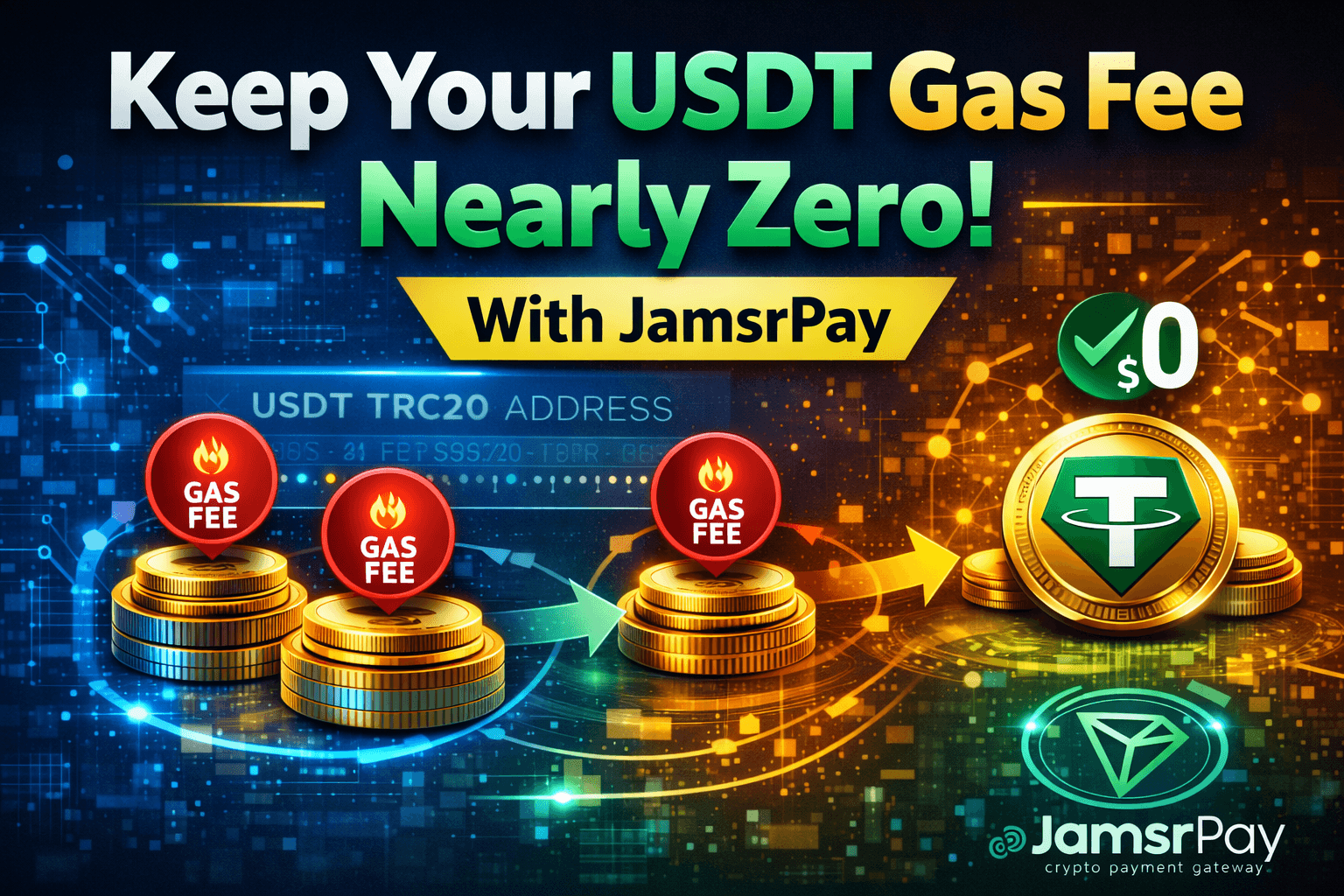
How to Keep Your USDT TRC20 Withdrawal Gas Fee Almost Zero on JamsrPay
Gas fees are one of the biggest hidden costs when accepting crypto payments—especially for USDT TRC20 merchants handling high transaction volumes.
While TRC20 is already known for high fees, frequent withdrawals and multiple on-chain transfers can still add up over time.
This is where JamsrPay introduces a smart solution that helps merchants save gas fees almost completely by using a same-address, multi-invoice payment system.
The Real Problem: Gas Fees Add Up Over Time
Many crypto payment systems work like this:
Even with TRC20, these repeated withdrawals slowly increase operational costs.
JamsrPay’s Smart Solution: Same Address, Multiple Invoices
JamsrPay solves this problem by allowing merchants to:
✅ Accept multiple invoices on the same USDT address
✅ Aggregate incoming payments automatically
✅ Withdraw funds once instead of multiple times
This means:
No repeated gas fee payments
Fewer on-chain transactions
Better fund management
How the Same-Invoice Address Feature Works on JamsrPay
One of the most powerful features of JamsrPay is its ability to reuse a single USDT TRC20 address across multiple invoices, allowing merchants to drastically reduce blockchain gas fees.
This system is designed to be secure, automated, and merchant-friendly, while keeping withdrawal costs almost zero.
Step-by-Step Flow (Invoice Address Lifecycle)1. Address Creation & Invoice Assignment
When a merchant creates an invoice, JamsrPay generates one unique USDT TRC20 address
This address is assigned to that invoice
The invoice is initially valid for 30 minutes on the frontend
This ensures customers have a clear and fixed time window to complete the payment.
2. Smart Backend Grace Period (30 + 30 Minutes)
Even if the invoice expires after 30 minutes on the frontend, JamsrPay continues to monitor the same address on the backend.
The backend keeps the invoice valid for up to 1 hour (60 minutes total)
If a customer sends USDT after the first 30 minutes but within 1 hour:
The payment is still accepted
The invoice is automatically marked as successful when the invoice page is refreshed
3. Successful Payment & Address Reuse
When an invoice is successfully completed:
The same USDT TRC20 address is temporarily locked
After 10 minutes, the address is:
Released
Reassigned to the next new invoice
This allows the same address to be reused safely for future invoices.
4. Multiple Invoices, One Address
With this system:
Merchants can accept multiple invoice payments
All payments are received on the same USDT address
Funds accumulate in a single balance
There is no limit to how many invoices can be paid using this flow.
5. One Withdrawal, One Gas Fee
Because all invoice payments go to the same address:
Merchants withdraw once
Only one blockchain transaction is required
Only one gas fee is paid
This keeps the effective USDT TRC20 gas fee almost zero, even for high-volume merchants.
Why This System Saves Massive Gas Fees
Most traditional crypto payment systems are not optimized for high-volume USDT payments. They generate unnecessary blockchain transactions, which increases gas costs over time.
JamsrPay solves this problem by using a same-address, multi-invoice system, dramatically reducing the number of on-chain transactions required.
Instead of paying gas fees per invoice, merchants pay gas fees per withdrawal.
Real-World Merchant Benefits
Merchants using this feature experience:
🔻 Up to 99% reduction in gas fees
⚡ Faster reconciliation
🔐 Lower operational risk
📊 Clean accounting & reporting
🚀 Better scalability for high-volume payments
This is especially beneficial for:
SaaS platforms
E-commerce businesses
Digital product sellers
Built for USDT TRC20 Optimization
USDT TRC20 is already known for highest gas fees, but JamsrPay takes it further by:
Smart invoice tracking
Time-based validation logic
Address reuse without security risks
Backend payment recovery for late payments
The result: maximum efficiency with minimum blockchain cost.
Perfect for USDT TRC20 Merchants
This feature is especially powerful for USDT TRC20, where:
Transactions are fast
Fees are already low
Energy management makes transfers extremely cheap
By combining TRC20 with JamsrPay’s smart invoice system, merchants can reduce their effective gas cost to almost zero.
Why This Matters for Growing Businesses
As your payment volume grows, inefficiencies grow with it.
JamsrPay’s same-address invoice feature ensures that:
Your gas fee costs don’t scale with transaction count
You stay profitable even with micro-payments
You don’t waste money on unnecessary blockchain fees
JamsrPay: Built for Smart Crypto Payments
JamsrPay isn’t just a crypto payment gateway—it’s built to optimize how merchants actually use blockchain.
By intelligently managing invoices, addresses, and withdrawals, JamsrPay helps businesses:
Save money
Scale faster
Operate globally with USDT
Final Thoughts
If you’re accepting USDT TRC20 payments and want to:
Minimize gas fees
Reduce withdrawal costs
Accept multiple payments efficiently
Then using JamsrPay’s same-invoice address feature is one of the smartest moves you can make.
Fewer blockchain transactions = fewer gas fees.
And fewer gas fees = higher profit margins.
That’s how JamsrPay keeps your USDT TRC20 gas fees almost zero while letting you scale payments effortlessly. 🚀
Frequently Asked Questions (FAQs)Q: What causes gas fees when withdrawing USDT?
A: Gas fees occur because every blockchain transaction requires computational work. When you withdraw USDT from a wallet or smart contract, the network requires a fee to process and confirm the transaction.
Q: How does the same-invoice address feature save gas fees?
A: By assigning multiple invoices to a single USDT address, merchants receive payments in one place and make only one withdrawal, reducing the number of on-chain transactions and gas fees.
Q: What is a USDT invoice?
A: A USDT invoice is a payment request generated by JamsrPay that includes an amount and a receiver address. When paid, it identifies a transaction on the blockchain linked to that invoice.
Q: Why keep invoices valid beyond 30 minutes?
A: A short frontend validity window ensures users pay promptly, while backend monitoring ensures that even late payments (up to 1 hour) are still accepted and correctly credited.
Q: Do I need a blockchain wallet to use JamsrPay?
A: Yes. To receive USDT payouts, you need a cryptocurrency wallet where JamsrPay will send your aggregated funds.
Q: Does JamsrPay hold my funds?
A: No. JamsrPay never stores merchant funds. All payments are forwarded or settled directly to your wallet.
Q: Are withdrawals automatic or manual?
A: JamsrPay supports both manual and automated withdrawal configurations depending on your preferences.
Q: Does this system work for all USDT networks?
A: This gas-saving system is optimized primarily for USDT TRC-20 because the TRON network offers very high transaction (gas) fees.
Q: What is the main advantage of using one address for multiple invoices?
A: It minimizes blockchain write operations, which directly reduces the number of times gas must be paid.
Q: Do I have to pay gas fees per invoice?
A: With JamsrPay’s system, gas fees are applied only when withdrawing the accumulated balance, not per individual invoice payment.
Q: How long does it take to confirm a TRC-20 USDT transaction?
A: TRC-20 transactions typically confirm in under 15 seconds due to the high throughput of the TRON network.
Q: What happens if two customers pay the same invoice at the same time?
A: If two customers send payments for the same invoice, both amounts are accepted and added together. JamsrPay’s backend tracks each incoming transaction in real time and updates the invoice balance accordingly.
If the combined amount matches the invoice value, the invoice is marked as completed
If the combined amount exceeds the invoice value, the invoice is marked as overpaid
This ensures that no funds are lost and all incoming payments are safely recorded, even in simultaneous or overlapping payment scenarios.
Q: Will I ever lose funds due to late payments?
A: No. Funds are never lost due to late payments. Each invoice is monitored on the backend for up to 1 hour, even though it expires on the frontend after 30 minutes.
If a payment is received within the 1-hour backend validation window, the invoice is automatically marked as successful.
If a payment is received after the 1-hour window, the invoice will not be marked as successful, but the funds are still safely received on the same USDT address.
In such cases, the payment remains in the merchant’s balance, and the merchant can manually credit the customer’s account. The amount is included in the next withdrawal, along with all other invoice payments received on the same address.
This approach ensures no funds are lost, even when payments arrive late.
Q: Does this feature save gas for merchants with high-volume payments?
A: Yes. The more transactions you receive, the more gas you save, because you withdraw fewer times.
Q: How does JamsrPay ensure secure tracking of payments?
A: Each payment is tracked by blockchain metadata, invoice reference, and timestamp by backend services to ensure authenticity and prevent misallocation.
Q: Do I need to pay for invoice validity extensions?
A: No. Invoice monitoring and extended validation are part of the JamsrPay backend process and require no additional merchant fee.
Q: How quickly can I withdraw my accumulated USDT?
A: Withdrawals can be configured to be instant or based on thresholds, depending on your business needs.
Q: Does this system help with accounting reconciliation?
A: Yes. Because all payments go to one address and are tracked with invoice metadata, reconciliation is more straightforward.
Q: Can I integrate this feature with my e-commerce store?
A: Yes. JamsrPay supports API and webhook integrations that allow you to automate UI display, confirmations, and backend processing.
Q: Is there a limit to how many invoices I can accept?
A: No. You can accept as many invoices as needed on the same address while still paying minimal gas during withdrawal.
Q: How does this help new crypto merchants?
A: New merchants benefit from reduced operational costs, simplified payment tracking, and smooth blockchain payment acceptance without complex fee calculation.
Q: What happens if multiple users request payment at the same time? Will all invoices use the same address?
A: No. When multiple users request payments at the same time, each invoice is assigned a different USDT address.
A single address is never shared between active invoices. Once an invoice is successfully completed or expires, that address is released. After a short cooldown period, the same address will be reassigned to a new invoice.
This design ensures:
Payments are correctly matched to the right invoice
No conflicts occur between simultaneous users
Address reuse remains safe and controlled
Q: How is the service fee paid on JamsrPay?
A: JamsrPay charges a service fee of 0.5% + $0.25 per transaction, and this fee is paid in TRX.
When a customer makes a payment, the funds are transferred directly from the temporary invoice address to the merchant’s wallet. The payment does not pass through a JamsrPay hot wallet to deduct the service fee.
Instead, the service fee is deducted separately using TRX from the merchant’s gas fee wallet on JamsrPay. This design ensures:
Faster settlements
No custody of merchant funds
Transparent fee handling
For this reason, merchants must ensure they have sufficient TRX balance in their gas fee wallet to cover service fees and network costs.
Q: Does the merchant need to pay gas fees for all supported tokens and networks?
A: Yes. Merchants are responsible for paying gas fees for the tokens and blockchain networks they use.
JamsrPay provides instant payouts directly to the merchant’s wallet and does not control or hold merchant funds. Because payments are settled on-chain in real time, each network requires its native token to cover transaction fees (for example, TRX for TRC-20).
Merchants must maintain sufficient gas balance for each enabled network in their JamsrPay dashboard to ensure smooth processing of service fees and withdrawals. This approach keeps the system fully non-custodial, transparent, and secure.
Q: Is this feature suitable for micro-payments?
A: Yes. By reducing the number of withdrawals, the system is especially effective for micro-payments where gas fees would otherwise consume a large portion of revenue.
Q: Who should use this gas-optimization feature?
A: This feature is ideal for merchants handling high-volume USDT payments, SaaS platforms, marketplaces, services, and digital product businesses.